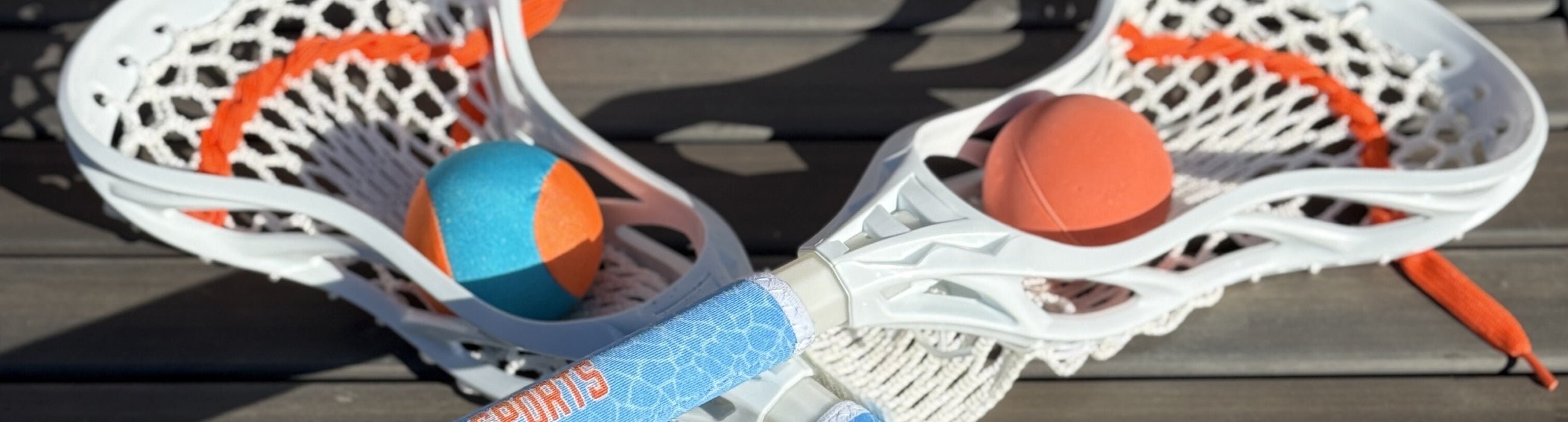
To adjust a mini lacrosse stick, you change two things: the pocket (re-weave the bottom strings into the row above or below the default to make the pocket deeper or shallower) and the shooting strings (move them higher for more hold or lower for a quicker release). A deeper pocket gives better ball control; a shallower pocket releases faster for passing and shooting. The full step-by-step for both is below.
If your kid is just starting out, there's nothing wrong with playing on the default setting. Most players use their sticks straight out of the box and find it perfectly fine for backyard catch. But once they start chasing accuracy on every pass, a few small tweaks to the pocket and strings can make the stick feel like their own. Here's how to do it together.
Do you need to adjust your lacrosse stick at all?
No — many players use their sticks with the default netting setting and find it perfectly fine for general play. However, more serious or competitive players often prefer to adjust the pocket to enhance their control and accuracy with the ball. If your child is happy with how the ball sits and throws, leave it alone. If they want more hold or a snappier release, that's when it's worth getting hands-on. Adjusting the pocket and strings is also a great rainy-day project for a kid learning how their Mini-Toss Lacrosse set actually works.
How do you adjust the lacrosse pocket and netting?
Adjusting the lacrosse pocket allows players to customize how the ball sits and releases from the stick. A deeper pocket can provide better ball control and handling, while a shallower pocket creates a quicker, more consistent release for passing and shooting. Fine-tuning the pocket also helps improve accuracy, confidence, and overall stick feel, making it easier to match the stick to a player’s position, skill level, and playing style. Follow these six steps:
1. UNTIE the strings holding the mesh in place at the bottom of the head. The strings are located at the back of the stick [A, B].
2. UNWEAVE the strings until they are no longer holding the pocket. Take note of what row the strings are in and also how they weave in and out of the net holes [C].

3. RE-WEAVE the strings into either the row above or below the default row [D, diagram] to make the pocket deeper or shallower — a deeper pocket gives more control, a shallower one a faster release. Use the row you noted in step 2 as your reference and try one direction at a time so you can feel the difference.

4. PULL STRINGS towards the front of the pocket and insert each string through the corresponding left and right holes. [E]

5. RE-TIE the strings securely. Done!
6. OPTIONAL: With adult supervision, cut off the excess mesh and use a lighter to singe the ends of the nylon to prevent fraying.
How do you adjust the shooting strings?
Shooting strings control how the ball releases from the pocket and play a major role in accuracy and shot consistency. Their placement affects how long the ball stays in the pocket during a pass or shot. Higher shooting strings increase hold and control, helping with accuracy, while lower shooting strings allow for a quicker release, which is ideal for fast passing and shooting. Adjusting shooting strings helps players fine-tune feel, release timing, and overall performance. Here's the four-step process:
- UNTIE and UNWEAVE the shooting strings, reposition the start of the strings, or keep it in the same spot. [F]

2. PULL the lengths of the strings until they are about even. This is easiest when the head of the stick is facing either left or right.
3. WEAVE both strings through each diamond going down the row. [G]
The back end is weaved below; the front end is weaved above [H, diagram], continue this pattern until you reach the end. [I]


4. TIE THE ENDS behind the head to secure in place. [J]

Should shooting strings be higher or lower?
Higher shooting string = more control; string placement keeps the ball in the pocket longer which improves accuracy and handling.
Lower shooting string = quicker release; good for fast passing and shooting, the ball will leave the pocket sooner.
The right answer depends on the player. A kid who wants to cradle and run the ball will like a higher string; a kid who loves whipping quick passes back and forth will like a lower one. It only takes a few minutes to re-string, so let them experiment until the stick feels right in their hands.
Frequently asked questions
Do I have to adjust my mini lacrosse stick?
No. The default netting setting works perfectly fine for general play and casual backyard catch. Adjusting the pocket and shooting strings is for players who want to fine-tune control, accuracy, and release for their position and style.
What does a deeper pocket do?
A deeper pocket gives better ball control and handling. A shallower pocket creates a quicker, more consistent release for passing and shooting.
How do I make my lacrosse stick release faster?
Set the pocket shallower and move the shooting strings lower. Both let the ball leave the pocket sooner for quicker passing and shooting.
Can kids do this themselves?
Older kids can handle the re-weaving with a little help, and it's a fun way to learn how the stick works. The final step — trimming excess mesh and singeing the nylon ends with a lighter — should only be done with adult supervision. Adjusting their Mini-Toss Lacrosse set is also a great low-screen project, right alongside the kind of backyard play that's so good for kids ages 3-11.